
Imagine someone in your area searching for exactly what you sell, but they find your competitor instead. That’s the reality for many small businesses that don’t show up on Google.
That’s where small business SEO comes in. It’s about helping your website appear when people are actively looking for your products or services. With the right approach, you can bring in steady traffic, calls, and customers without paying for ads.
In this guide, you’ll find simple SEO tips for small businesses you can start applying today. Everything here is written in plain English, focused on real results, and made for business owners who just want more people to find them online.
What Is Small Business SEO (and Why It Matters)
Small business SEO means improving your website so it shows up higher when people search for what you offer. It’s about making it easy for Google to understand who you are, what you sell, and where you are located. When done right, it helps the right customers find you instead of your competitors.
Good SEO builds trust. People tend to click on businesses that appear near the top of the search results because they see them as more reliable. It also brings steady traffic without the constant cost of ads, which makes it one of the smartest ways to grow your revenue.
These SEO tips for small businesses are designed for owners who don’t have big budgets or a full marketing team. Even small improvements can make a big difference in how many people visit your site and contact your business.
Small Business SEO vs Local SEO (and How AI Is Changing Both)
When people talk about small business SEO, they often mix it up with local SEO. They’re related but not quite the same. Small business SEO focuses on helping your website reach customers searching for your products or services anywhere, while local SEO helps you show up when people nearby search for what you offer.
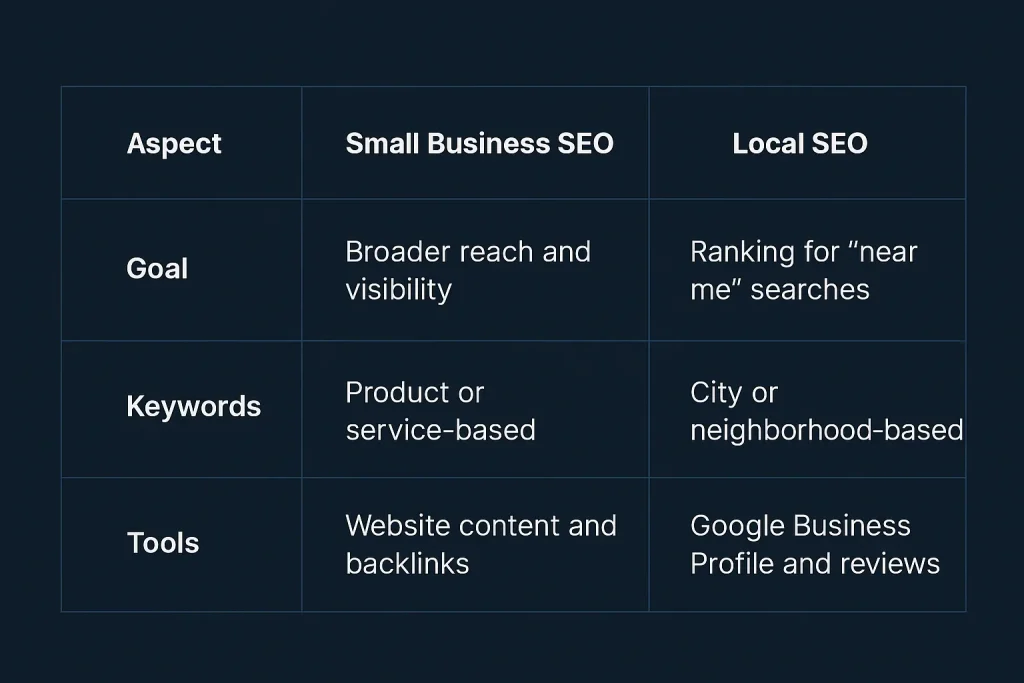
Most small business SEO strategies include local SEO tactics, since most small businesses serve specific areas. Having both in place helps you appear in regular Google searches and in the local map results.
Search is also changing. Google is testing new features like AI Overviews that summarize answers right in the results. Other tools, like ChatGPT or Perplexity, are changing how people discover information. This means your content needs to be clear, helpful, and trustworthy so it can be picked up and quoted by these systems.
You may hear terms like GEO (Generative Engine Optimization), AEO (Answer Engine Optimization), and AIO (Artificial Intelligence Optimization). These are newer ideas in SEO that focus on writing content that AI and voice tools can easily understand. For now, what matters most is keeping your content useful, simple, and written for people first.
Lay the SEO Foundation for Your Small Business
Before anything else, your small business SEO success depends on getting the basics right. These are the simple steps that help Google understand your business and build trust with new customers.
Claim and Optimize Your Google Business Profile
One of the easiest SEO tips for small businesses is to optimize your Google Business Profile. It’s free, and it helps you show up in local searches and Google Maps when people look for what you sell.
Make sure to:
- Pick the correct business category
- Add accurate hours and contact details
- Upload clear photos of your business, team, or products
- List your main services
- Encourage happy customers to leave reviews
A complete profile builds credibility and brings more local visitors your way.
Fix Your NAP and Directory Listings
NAP consistency is a crucial part of small business SEO success. NAP stands for Name, Address, and Phone number, and these details should match exactly everywhere your business appears online.
Start by checking your listings on:
- Yelp
- Better Business Bureau (BBB)
- Chamber of Commerce websites
- Industry or local directories
When your details are consistent, search engines trust your business more and are more likely to show it in results.
Build a Search-Friendly Website Structure
Every small business SEO plan starts with a clean, easy-to-crawl website. Google should be able to move through your pages without getting lost, and visitors should find what they need in seconds.
Here are the basics:
- Keep navigation simple (Home, Services, About, Contact, Blog)
- Use short, clear URLs that describe the page topic
- Add internal links so visitors can move between pages easily
- Make sure your site loads fast and looks good on phones
A solid website structure helps both people and search engines understand your business better.
Keyword Research Made Simple for Small Businesses
Before you can rank on Google, you need to know what people are actually searching for. Keyword research is the foundation of every small business SEO effort. It shows you which words and phrases your customers use when looking for your products or services.
These SEO tips for small businesses focus on keeping keyword research simple. You don’t need fancy tools or deep data. Just think about what people would type into Google if they needed what you offer.
Start with two types of keywords:
- Service keywords describe what you do, like “wedding photographer” or “home cleaning services.”
- Location keywords describe where you operate, like “wedding photographer in Chicago” or “home cleaning services near me.”
Combine them to create phrases that are easier to rank for and bring the right kind of visitors.
Choosing the Right Small Business SEO Keywords
When picking your target keywords, look for phrases that meet two rules:
- Low competition so you have a real chance to rank
- High intent so the person searching is ready to buy or contact you
For example, “best bakery in Dallas” is a better choice than “bakery” because it’s specific and easier to compete for.
Tip: focus on low-difficulty, high-intent phrases. They are perfect for small businesses just starting with SEO. Over time, you can target broader terms once your site builds more authority.
Create Pages That Rank and Convert
Your website pages are where visitors decide if they want to contact you or move on. Building the right pages with clear content and calls to action helps Google understand what you offer and helps customers take the next step.
Service Pages
Each core page should be optimized for your main small business SEO keywords. These pages should focus on the specific services you offer and answer common questions customers might have.
For example, if you own a landscaping company, you might have separate pages for lawn care, tree trimming, and garden design. Each one should:
- Use your target keyword in the title, H1, and the first sentence
- Clearly describe what you do and who it’s for
- Include photos, reviews, or examples of your work
- End with a simple call to action like “Request a quote” or “Book a consultation”
The goal is to help visitors understand your service quickly and feel confident reaching out.
Location Pages
For better small business SEO results, create separate location pages for each city or area you serve. This helps Google connect your business to local searches and gives potential customers nearby information they can trust.
These pages should include:
- The city or neighborhood name in the title and headings
- Local contact details and directions
- Testimonials or photos from that area
- A short description of the services you offer there
These SEO tips for small businesses targeting multiple cities make it easier for you to show up in both map and organic results.
Blog Content That Builds Authority
Blog posts are a great way to apply ongoing SEO tips for small businesses and keep your website fresh. Blogs help you answer customer questions, share useful advice, and build trust over time.
Examples of good topics include:
- “Best SEO tools for small business owners”
- “How to improve small business SEO in 30 days”
- “Common website mistakes that hurt local rankings”
Use clear titles, short paragraphs, and helpful information. Each blog post can attract new visitors and show Google that your website is active and valuable.
Format for AI, Voice, and Featured Snippets
You can make your content more visible in voice searches and quick answers by creating AI-friendly small business SEO content. This means writing short, clear responses to common questions.
Add a few FAQs at the end of your main pages. For example:
- “How to improve small business SEO quickly?”
- “What are the best SEO tips for small businesses?”
Keep answers under 60 words and use bullet points or numbered lists where possible. This format helps search engines understand your content and may increase your chances of showing up in featured results.
Technical SEO Basics for Small Businesses
This technical small business SEO checklist covers speed, structure, and indexing. It’s about making sure your website runs smoothly, loads fast, and is easy for Google to read and rank. You don’t need to be a developer to handle most of these steps.
Start by checking your website with free tools like Google Search Console and PageSpeed Insights. Search Console helps you spot crawl errors, broken links, or pages that aren’t showing up in search results. PageSpeed Insights shows how quickly your site loads and gives simple fixes to make it faster.
Here are a few easy wins to keep your site in good shape:
- Check for broken links: Fix or remove any links that lead to missing pages.
- Keep your URLs short and descriptive: Use plain words instead of random numbers or symbols.
- Make your site mobile-friendly: Most people search from their phones, so your site should look and work great on small screens.
- Improve site speed: Site speed improvements are one of the simplest SEO tips for small businesses. Compress large images, remove unused plugins, and choose reliable hosting.
- Add an XML sitemap: This helps Google find all your pages quickly.
- Use HTTPS: A secure connection builds trust with visitors and can slightly improve rankings.
Technical SEO may sound complex, but it’s mostly about keeping your website clean and easy to use. A fast, well-structured site gives your visitors a better experience and helps your rankings grow over time.
Reviews, Backlinks, and Local Authority
Getting noticed online isn’t just about your website. Your reputation and connections across the web also influence how Google sees your business. Reviews and backlinks are two key parts of small business SEO that show search engines you’re trusted and active in your community.
Collect Reviews That Boost Rankings
Reviews are one of the most powerful small business SEO signals. They help your business look credible, attract more clicks, and improve your visibility in Google Maps and local results.
Here’s how to make them work for you:
- Ask every customer to leave a review right after a purchase or completed service.
- Make it easy by sharing a direct link to your Google Business Profile.
- Always reply to reviews, both positive and negative, to show you value feedback.
- Share your best reviews on your website or social media.
SEO tips for small businesses: ask for reviews immediately after a service is completed. It’s when customers are happiest and most likely to share their experience.
Earn Backlinks That Matter
Local backlinks remain a top small business SEO ranking factor. Backlinks are links from other websites pointing to yours, and they act as trust signals to Google. The more reputable the website linking to you, the stronger your authority becomes.
Simple ways to earn quality backlinks:
- Partner with local blogs or community websites.
- Sponsor a local event, charity, or sports team.
- Write guest articles for local business sites or industry blogs.
- Ask your suppliers or partners to feature you on their websites.
These links not only boost your search visibility but can also send new customers directly to your site.
Ready to level up your small business SEO? Start by earning 3–5 backlinks this month. It’s a small step that can make a big difference in your rankings.
Future-Proof Your Small Business SEO (GEO, AEO, AIO)
To stay visible in AI-driven search, small business SEO strategies must evolve. Search results are changing as Google and other platforms use AI to summarize information and answer questions directly. This does not mean SEO is going away. It simply means your content needs to be clearer and more useful than ever.
Think of this as AI search optimization, which complements traditional SEO. The goal is still the same: provide real answers that help people decide, in a way that search engines and AI systems can easily understand.
Here’s what each new concept means in simple terms:
- GEO (Generative Engine Optimization): Create helpful and easy-to-understand content that AI tools can quote or summarize. Use clear language and support your points with facts or examples.
- AEO (Answer Engine Optimization): Format your content to answer common questions directly. Use short paragraphs, bullet points, and FAQs that deliver quick, simple answers.
- AIO (Artificial Intelligence Optimization): Keep your site structure clear and organized. Use headings that describe what the page is about and avoid keyword stuffing.
These ideas build on traditional SEO and prepare your content for how people search today. You could call them AI SEO tips for small businesses, but at the core, it’s about creating clear, useful, and trustworthy information that genuinely helps your audience.
Track What Matters in Small Business SEO
You can’t improve your small business SEO without tracking progress. Knowing what’s working and what isn’t helps you make smarter decisions and focus your time where it counts. Even simple tracking can show whether your efforts are turning into real growth.
Here are the key things to monitor:
- Leads: Track how many calls, form submissions, or messages come from your website or Google Business Profile.
- Organic traffic: Use tools like Google Analytics to see how many people find your site through search.
- Keyword rankings: Check if your target keywords are moving up or down in results over time.
- Google Business Profile activity: Keep an eye on how many views, clicks, and directions requests your profile gets each month.
Look at these numbers regularly and adjust your strategy as needed. Small shifts, like improving a page title or adding new content, can often lead to noticeable gains.
Measuring results keeps your small business SEO strategy focused. When you know what works, you can spend less time guessing and more time growing your business.
Common Mistakes To Avoid
Even when you understand the basics of small business SEO, it’s easy to overlook small details that make a big difference. Many websites lose potential traffic simply because of a few avoidable errors.
Here are the most common ones to watch out for:
- Keyword stuffing: Adding your target keywords too many times hurts readability and rankings. Write for people first, not search engines.
- Slow or mobile-unfriendly sites: Most local searches happen on phones. If your site loads slowly or doesn’t fit small screens, visitors will leave fast.
- Ignoring reviews: Reviews are one of the strongest ranking signals for local searches. Always ask for feedback and respond to it.
- Skipping local pages: If you serve more than one city or area, create dedicated pages for each. It helps Google understand where you operate.
- Not tracking results: Without data, you can’t know if your SEO work is paying off. Check your traffic and keyword rankings regularly.
Fixing these issues early makes your small business SEO efforts more effective and prevents wasted time trying to rank with a weak foundation.
Conclusion
Strong small business SEO can put you ahead of competitors and keep your business visible long-term. Even small, steady improvements can bring more visitors, more leads, and stronger brand credibility over time.
The key is consistency. Keep optimizing your pages, earning reviews, and adding helpful content that answers your customers’ questions.Apply these SEO tips for small businesses consistently, and you’ll see progress build month after month. If you’re ready to take your SEO to the next level, schedule a free call with our team to see how we can help you grow faster and attract more customers.